

Kala Red Light LED Face Mask— Expert Review
Overview
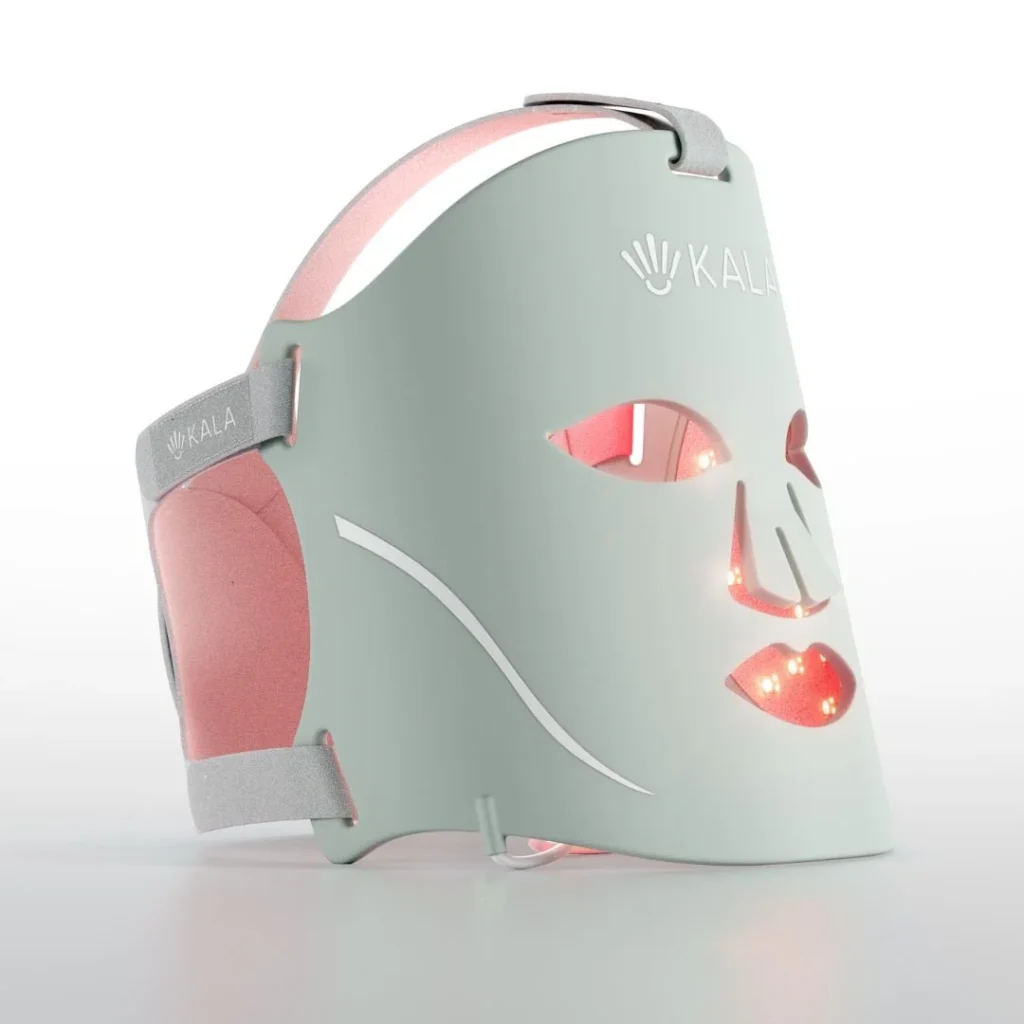
The Kala Red Light LED Face Mask positions itself as a practical middle ground between clinical-grade devices and budget consumer options. On paper, it delivers a compelling mix: FDA clearance, triple-wavelength therapy (red, near-infrared, and blue), and a flexible, travel-friendly design—all at a price that undercuts many premium competitors.
But LED masks are a category where specs can be misleading if not interpreted carefully. Power, coverage, wavelength control, and usability all interact in ways that determine real-world results. So while Kala checks many boxes, the more important question is: how well do those boxes translate into outcomes on actual skin?
Performance & Light Therapy Effectiveness
At the core of any LED mask is its ability to deliver a therapeutically meaningful dose of light consistently across the face.
Kala performs solidly—but not exceptionally—here.
- The 26 mW/cm² irradiance is genuinely respectable for this price range. Many masks overpromise and underdeliver, but independent measurements suggest Kala hits clinically relevant output.
- A 10-minute session yielding ~15.6 J/cm² places it slightly above the commonly cited optimal window (around 5–10 J/cm² for skin). This isn’t inherently negative—it may actually accelerate results—but it reduces flexibility for users who prefer to fine-tune dosage.
Where things get more nuanced:
- Red (630 nm): Helps support skin repair processes and improves overall skin tone and brightness.
- Near-infrared (830 nm): Penetrates deeper, supporting collagen synthesis and circulation.
- Blue (465 nm): Targets acne-causing bacteria (C. acnes), making the mask more versatile than red-only competitors.
It’s a bit of a nuanced answer — it depends on which wavelengths you’re talking about.
Red + Near-Infrared (830 nm): YES, these two can run together. You can run red and NIR together in the same session, which is actually the default mode when you power the mask on.
Blue + Red/NIR: NO, blue must be used separately. You select which light color you want to use, and the LEDs emit only that wavelength — they can only deliver one type of light at any given moment and don’t combine or layer multiple wavelengths simultaneously the way some other masks do. So blue is always its own standalone mode.
In practice, your options are:
- Red + Near-Infrared together (the main anti-aging/rejuvenation mode)
- Blue light only (the acne-targeting mode)
So it’s not quite one color at a time across the board — red and NIR are paired — but you can’t run all three at once. This is a notable limitation compared to some competitors that do allow true simultaneous multi-wavelength delivery.
Bottom line: The light quality is legitimate, but delivery is somewhat constrained.
Coverage: The Hidden Weak Point
If there’s one area where Kala clearly underperforms, it’s LED distribution and facial coverage.
Despite having 66 triple-chip LEDs (198 chips total), the placement is uneven:
- Noticeable gaps around the jawline
- Limited exposure for the under-eye region
- Inconsistent coverage on the upper forehead
This matters more than raw LED count. In LED therapy, uniform exposure often outweighs intensity, especially for anti-aging, where collagen stimulation should be evenly distributed.
In practice, this means:
- You may see good results in central facial areas (cheeks, nose)
- But less improvement in peripheral zones, which can create uneven outcomes over time
This is one of the key reasons the mask lands in a mid-tier ranking rather than top-tier, despite respectable specs elsewhere.
Design & Usability
Kala leans heavily into comfort and practicality, and this is one of its strongest areas.
- The soft silicone construction adapts well to different face shapes without pressure points.
- At 348 g, it’s lightweight enough for longer sessions.
- The foldable design makes it genuinely travel-friendly—a rare but valuable feature.
However, usability is a mix of thoughtful simplicity and frustrating limitations:
What works well:
- Simple one-button control
- Straightforward 10- and 20-minute timers
- Minimal learning curve (great for beginners)
What doesn’t:
- No intensity adjustment
- No pulsed light mode (which some studies suggest may enhance cellular response)
- No ability to isolate red light without NIR
The corded controller is another minor annoyance. It doesn’t ruin the experience, but it does detract from the otherwise modern, portable feel.
Build Quality & Practical Considerations
Kala strikes a decent balance between durability and portability:
- Medical-grade silicone feels premium and resilient
- USB-C charging is a welcome modern touch
- A 4-hour charge time is slower than ideal but manageable
The 2-year warranty is above average for this category, which adds some confidence.
That said, return policy variability is worth paying attention to. LED masks are highly individual—fit and comfort matter more than expected—so a restrictive return policy introduces some purchasing risk.
Real-World Results
User feedback aligns closely with what the specs suggest:
Positive trends:
- Improved skin tone and radiance after 3–6 weeks
- Reduction in mild acne and redness
- Some users report benefits for inflammatory conditions like eczema
Limitations:
- Results are gradual, not dramatic
- Some users notice no change in the first 1–2 weeks, which is normal but can be discouraging
- Likely less effective for deeper wrinkles compared to higher-density masks
Consistency is key here. Like most LED devices, Kala rewards routine use (3–5 times per week) rather than occasional sessions.
Value for Money
At around $289, Kala sits in an interesting position:
- Better equipped than entry-level masks
- Noticeably less advanced than premium ($600–$800) models
- Blue light for treating acne is not found is most mats
You’re essentially paying for:
- Verified output
- Triple-wavelength versatility
- Strong comfort and portability
But you’re not getting:
- High-density LED coverage
- Advanced customization
- Maximum efficiency per session
So the value depends on expectations. If you’re comparing it to spa treatments, it’s cost-effective. If you’re comparing it to top-tier home devices, the compromises become clearer.
Pros & Cons (Expert Take)
Pros
- Clinically relevant irradiance and dosage
- Includes blue light (rare at this price point), which is great for treating acne
- Comfortable, flexible, and travel-friendly
- Simple, beginner-friendly operation
- Solid certification profile and 2-year warranty
- 30-day money-back guarantee
Cons
- Uneven LED coverage (the biggest drawback)
- No multi-wavelength stacking
- No intensity or pulsing options
- Slightly inefficient treatment workflow
- Blue light must run as a separate cycle
- Return policy may be restrictive
Final Verdict
The Kala LED Face Mask is a competent, well-rounded device that plays it safe.
It doesn’t mislead with fake specs or underpowered output—that alone puts it ahead of many competitors. But it also doesn’t push into truly high-performance territory due to its coverage gaps and lack of advanced features.
Think of it as a “reliable generalist”:
- Good for building a consistent skincare routine
- Good for mild to moderate concerns (tone, acne, early aging)
- Less ideal for users seeking maximum anti-aging impact or precision treatment
Overall Score: 7/10
Best suited for:
Users who want a trusted, no-fuss LED mask with real therapeutic output at a reasonable price.
Not ideal for:
Those chasing clinic-level results, full-face uniformity, or highly customizable treatments.
If you want to compare Kala directly with top competitors like CurrentBody, Omnilux, or Therabody, go to: https://redlighttherapy.online/best-led-red-light-face-masks-2026-reviews-buyers-guide/